Currency
 AED
AED
 AFN
AFN
 ALL
ALL
 AMD
AMD
 ANG
ANG
 AUD
AUD
 AWG
AWG
 AZN
AZN
 BAM
BAM
 BBD
BBD
 BDT
BDT
 BIF
BIF
 BND
BND
 BOB
BOB
 BSD
BSD
 BWP
BWP
 BZD
BZD
 CAD
CAD
 CDF
CDF
 CHF
CHF
 CRC
CRC
 CVE
CVE
 CZK
CZK
 DJF
DJF
 DKK
DKK
 DOP
DOP
 DZD
DZD
 EGP
EGP
 ETB
ETB
 EUR
EUR
 FJD
FJD
 FKP
FKP
 GBP
GBP
 GMD
GMD
 GNF
GNF
 GTQ
GTQ
 GYD
GYD
 HNL
HNL
 HUF
HUF
 IDR
IDR
 ILS
ILS
 INR
INR
 ISK
ISK
 JMD
JMD
 JPY
JPY
 KES
KES
 KGS
KGS
 KHR
KHR
 KMF
KMF
 KRW
KRW
 KYD
KYD
 KZT
KZT
 LAK
LAK
 LBP
LBP
 LKR
LKR
 MAD
MAD
 MDL
MDL
 MKD
MKD
 MMK
MMK
 MNT
MNT
 MUR
MUR
 MVR
MVR
 MWK
MWK
 MYR
MYR
 NGN
NGN
 NIO
NIO
 NPR
NPR
 NZD
NZD
 PEN
PEN
 PGK
PGK
 PHP
PHP
 PKR
PKR
 PLN
PLN
 PYG
PYG
 QAR
QAR
 RON
RON
 RSD
RSD
 RWF
RWF
 SAR
SAR
 SBD
SBD
 SEK
SEK
 SGD
SGD
 SHP
SHP
 SLL
SLL
 STD
STD
 THB
THB
 TJS
TJS
 TOP
TOP
 TTD
TTD
 TZS
TZS
 UAH
UAH
 UGX
UGX
 USD
USD
 UYU
UYU
 UZS
UZS
 VND
VND
 VUV
VUV
 WST
WST
 XAF
XAF
 XCD
XOF
XPF
XCD
XOF
XPF
 YER
YER


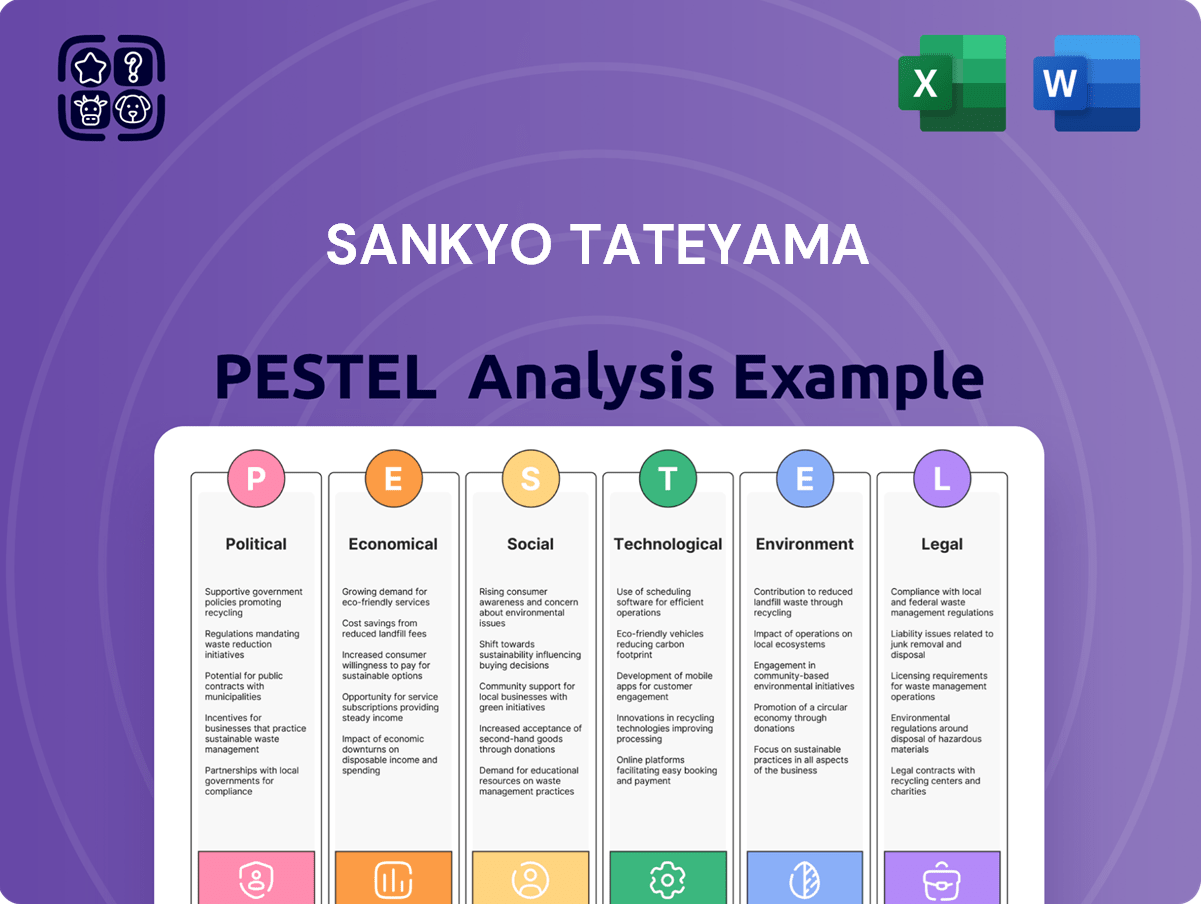

Description
x
Your Shortcut to Market Insight Starts Here
Discover how regulatory shifts, market dynamics, and technological trends are reshaping Sankyo Tateyama’s strategic landscape—our concise PESTLE snapshot highlights the risks and opportunities you need to know; purchase the full PESTLE analysis for a complete, actionable report ready for investment, planning, or competitive intelligence.
Political factors

Government Housing and Renovation Subsidies
The Japanese government’s 2025 subsidy push—¥1.2 trillion for energy-efficient housing and ¥450 billion for seismic retrofits—boosts demand for Sankyo Tateyama’s high-performance aluminum sashes and thermal insulation; these segments reported a 9% revenue lift in FY2024 tied to public incentives. Decision-makers should track continuation of these fiscal programs, as they remain the primary growth driver for the domestic residential business.
International Trade Policies and Tariffs
Global trade tensions and protective tariffs—for example US Section 232 measures and EU provisional duties on certain aluminum products, raising effective import costs by up to 10–25% in 2023–24—directly reduce Sankyo Tateyama’s export competitiveness in key markets. Political shifts toward regionalism increase customs complexity and risk of retaliatory duties, adding variable landed-costs and working-capital requirements. Strategic planning must model these geopolitical swings to protect FY2024–25 margins and pricing.

Geopolitical Supply Chain Stability
Ongoing geopolitical instability in bauxite- and aluminum-rich regions (e.g., Guinea, Indonesia) compels Sankyo Tateyama to align with Japan’s 2024 resource security policies, including the 50% diversification target for critical minerals; disruptions could raise alumina premiums by 15–25% versus 2023 levels.
Political alliances and trade agreements—such as Japan-EU EPA and CPTPP-linked supplier ties—are critical to maintain a steady raw-material flow to Japanese manufacturers, with 30–40% of primary aluminum imports tied to such frameworks in 2024.
The company must adopt proactive risk management—strategic stockpiles, multi-sourcing, and contractual force-majeure clauses—to mitigate sudden diplomatic shifts that in 2022–24 caused shipment delays averaging 18–22 days for some suppliers.

Infrastructure Development Initiatives
Japan’s 2025 budget allocates ¥1.6 trillion to disaster prevention and infrastructure resilience, supplying steady public contracts for Sankyo Tateyama’s civil engineering and building units and offsetting private-sector volatility.
Policy emphasis on aging infrastructure renewal—¥3.2 trillion over 2024–2025—boosts demand for the company’s aluminum exterior products used in retrofits and seismic reinforcement.
Analysts should treat these public investments as revenue stabilizers; public construction spending rose 4.8% YoY in 2024, smoothing cyclicality.
- ¥1.6T 2025 disaster prevention budget
- ¥3.2T aging infrastructure renewals (2024–2025)
- Public construction +4.8% YoY in 2024
Energy Policy and Industrial Regulation
Stringent political mandates require manufacturers to cut industrial energy consumption 30% by end-2025, forcing Sankyo Tateyama to invest in greener smelting and extrusion—potential capex estimated at JPY 6–10 billion to meet efficiency and emissions targets.
Compliance is tied to operating licenses and access to government green loans; Japan’s green financing programs offered about JPY 3 trillion in 2024, presenting funding avenues if regulatory milestones are met.
- 30% energy reduction target by 2025
- Estimated capex JPY 6–10B for facility upgrades
- Access to JPY 3T national green financing (2024)
Sankyo Tateyama: Government spend boosts retrofits; margins hit by duties, raw‑material costs
Political drivers—¥1.6T disaster prevention (2025), ¥3.2T aging infrastructure (2024–25), public construction +4.8% YoY (2024)—support Sankyo Tateyama’s retrofit and civil units; trade barriers (10–25% duties 2023–24) and resource risks (alumina premiums +15–25%) pressure margins; 30% energy cut target by 2025 requires JPY 6–10B capex but enables access to JPY 3T green financing (2024).
| Item | Value/Impact |
|---|---|
| Disaster budget (2025) | ¥1.6T |
| Aging infra (2024–25) | ¥3.2T |
| Public construction YoY (2024) | +4.8% |
| Import duties (2023–24) | +10–25% |
| Alumina premium vs 2023 | +15–25% |
| Energy cut target | −30% by 2025 |
| Estimated capex | JPY 6–10B |
| Green financing (2024) | JPY 3T |
What is included in the product
 Detailed Word Document
Explores how macro-environmental forces specifically impact Sankyo Tateyama across Political, Economic, Social, Technological, Environmental, and Legal dimensions, with each section grounded in current data and trends to identify risks, opportunities, and actionable insights for executives, investors, and strategists.

 Customizable Excel Spreadsheet
A compact, easily shareable Sankyo Tateyama PESTLE digest that segments political, economic, social, technological, legal and environmental factors for quick team alignment and insertion into presentations or planning documents.
Economic factors

Raw Material Cost Volatility
Fluctuating primary aluminum prices on the LME—rising from about $2,300/ton in Jan 2024 to peaks near $2,850/ton in mid-2025—remain a key economic pressure on Sankyo Tateyama’s margins, forcing use of hedging and pass-through clauses. Persistent 2024–25 global supply-demand gaps, with global refined supply growth under 1% annually, intensified pricing volatility and input cost risk. Investors should assess the company’s hedging coverage and whether it achieved >80% cost pass-through in 2025 for building and industrial contracts.
Currency Exchange Rate Fluctuations
As a Japanese firm importing aluminum ingots and exporting industrial components, Sankyo Tateyama’s margins are sensitive to Yen moves; between 2023–2025 the Yen weakened ~12% vs USD, raising raw-material costs in JPY terms. A weaker Yen increases aluminum procurement expenses while improving price competitiveness overseas, evidenced by Japan exports rising 5.7% y/y in 2024. Financial teams must monitor BOJ policy shifts—negative rates ended in 2023—which alter transactional and translational FX exposure.

Interest Rate Trends and Housing Starts
Japan's shift to higher interest rates by 2025—BOJ policy normalization and 10-year JGB yields rising from ~0.1% in 2022 to ~0.8%–1.0% in 2024–25—has cooled new residential housing starts, which fell 6.5% year-on-year in 2024 to ~780,000 units, reducing demand for aluminum sashes.
Higher mortgage rates (average new home loan rates up ~0.7–1.0 percentage points since 2022) have cut buyer affordability, redirecting spend toward renovations; Japan's renovation market grew ~4% in 2024, offering a mitigation path.
Sankyo Tateyama should pivot to products and distribution for the secondary market—targeting retrofit windows and maintenance contracts—to capture value and offset declining new-build volumes.

Labor Cost Inflation and Shortages
- 2024 wage inflation: manufacturing +2.5%, construction +3.1%
- Japan working-age population decline ongoing since 2010
- Automation targets: labor-hour cuts 20–30%, higher OEE
- Capex reallocation in 2024–25 toward labor-saving tech
Global Industrial Demand Cycles
The demand for Sankyo Tateyama’s aluminum extrusions tracks global automotive and electronics cycles; vehicle production fell 3.5% globally in 2024 versus 2023, pressuring orders for transport components.
Economic slowdowns in key markets like China and Europe reduced industrial machinery shipments—China industrial output growth slowed to 3.8% in 2024—lowering short-term demand for specialty profiles.
Diversifying clients across APAC, Europe and North America and into renewable energy components helped; exports made up about 62% of revenue in FY2024, cushioning regional downturns.
- Auto/electronics dependence: vehicle production -3.5% (2024)
- China industrial output: 3.8% growth (2024)
- Exports ≈62% of revenue (FY2024)
Aluminum surge, weaker yen & wage pressure drive automation shift as housing cools
Aluminum LME volatility (≈$2,300→$2,850/t, 2024–mid‑2025) plus ~12% JPY depreciation vs USD raised input costs; wage inflation (manufacturing +2.5% in 2024) and higher JGB yields cooled housing (-6.5% starts, 2024) but renovation +4% and exports ≈62% of revenue mitigate demand shifts; capex pivot to automation targets 20–30% labor-hour cuts.
| Metric | Value (2024/2025) |
|---|---|
| LME aluminum | $2,300→$2,850/t |
| JPY vs USD | -12% |
| Wage inflation | +2.5% mfg |
| Housing starts | -6.5% |
| Exports | ≈62% rev |
What You See Is What You Get
Sankyo Tateyama PESTLE Analysis
The preview shown here is the exact Sankyo Tateyama PESTLE Analysis document you’ll receive after purchase—fully formatted, professionally structured, and ready to use.

- Choosing a selection results in a full page refresh.