Currency
 AED
AED
 AFN
AFN
 ALL
ALL
 AMD
AMD
 ANG
ANG
 AUD
AUD
 AWG
AWG
 AZN
AZN
 BAM
BAM
 BBD
BBD
 BDT
BDT
 BIF
BIF
 BND
BND
 BOB
BOB
 BSD
BSD
 BWP
BWP
 BZD
BZD
 CAD
CAD
 CDF
CDF
 CHF
CHF
 CRC
CRC
 CVE
CVE
 CZK
CZK
 DJF
DJF
 DKK
DKK
 DOP
DOP
 DZD
DZD
 EGP
EGP
 ETB
ETB
 EUR
EUR
 FJD
FJD
 FKP
FKP
 GBP
GBP
 GMD
GMD
 GNF
GNF
 GTQ
GTQ
 GYD
GYD
 HNL
HNL
 HUF
HUF
 IDR
IDR
 ILS
ILS
 INR
INR
 ISK
ISK
 JMD
JMD
 JPY
JPY
 KES
KES
 KGS
KGS
 KHR
KHR
 KMF
KMF
 KRW
KRW
 KYD
KYD
 KZT
KZT
 LAK
LAK
 LBP
LBP
 LKR
LKR
 MAD
MAD
 MDL
MDL
 MKD
MKD
 MMK
MMK
 MNT
MNT
 MUR
MUR
 MVR
MVR
 MWK
MWK
 MYR
MYR
 NGN
NGN
 NIO
NIO
 NPR
NPR
 NZD
NZD
 PEN
PEN
 PGK
PGK
 PHP
PHP
 PKR
PKR
 PLN
PLN
 PYG
PYG
 QAR
QAR
 RON
RON
 RSD
RSD
 RWF
RWF
 SAR
SAR
 SBD
SBD
 SEK
SEK
 SGD
SGD
 SHP
SHP
 SLL
SLL
 STD
STD
 THB
THB
 TJS
TJS
 TOP
TOP
 TTD
TTD
 TZS
TZS
 UAH
UAH
 UGX
UGX
 USD
USD
 UYU
UYU
 UZS
UZS
 VND
VND
 VUV
VUV
 WST
WST
 XAF
XAF
 XCD
XOF
XPF
XCD
XOF
XPF
 YER
YER



Description
x
Skip the Research. Get the Strategy.
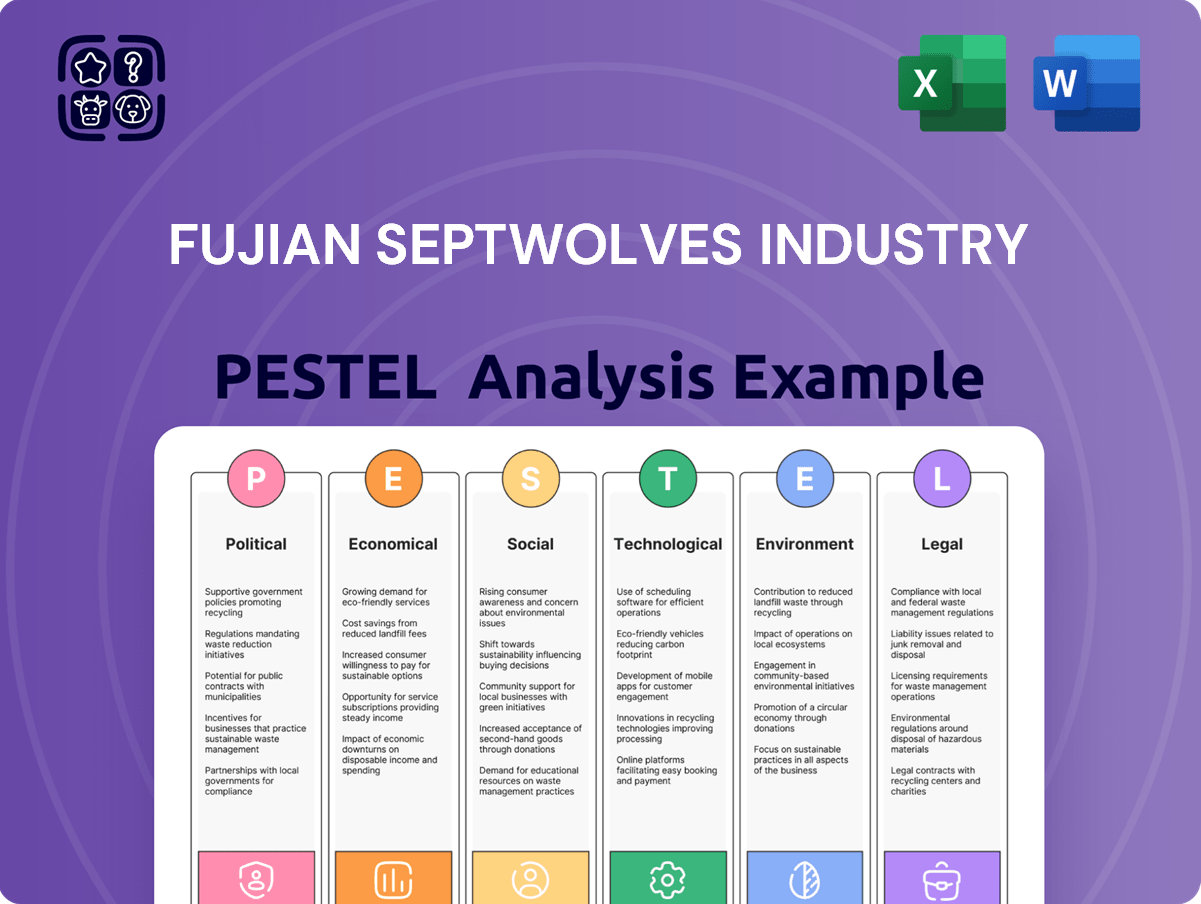
Gain a strategic edge with our PESTLE Analysis of Fujian Septwolves Industry—uncover how political shifts, economic trends, social preferences, and regulatory changes shape its market position and growth potential; buy the full report to access actionable insights, risk forecasts, and editable charts designed for investors, consultants, and strategists.
Political factors

Government support for domestic brands
The Chinese government’s Common Prosperity and Buy China drives boost domestic brands like Septwolves; retail policy in late 2025 targets raising household consumption to 47% of GDP, supporting local apparel demand.
Fiscal measures including a 2025 consumer stimulus package (RMB 300–400 billion) and tariff adjustments favor homegrown firms, improving Septwolves’ competitive position versus foreign brands.
Geopolitical tensions and trade barriers
Ongoing trade frictions between China and Western nations have pushed global textile input costs up; cotton futures rose ~18% in 2024 and Chinese import tariffs/transport delays increased COGS for apparel makers by ~4–6% per industry reports.
Septwolves’ domestic focus limits short‑term exposure, but retaliatory tariffs or 2024 export controls on textiles could hinder international revenue targets (management aimed to grow export sales 10–12% by 2025).
To navigate uncertainty, management should diversify suppliers—China's regional imports from ASEAN rose 22% in 2024—and leverage RCEP/other trade pacts to stabilize margins and supply chains.

Textile industry regulatory oversight
Strict CCP oversight mandates compliance with labor laws and industrial standards; in 2024 China fined textile firms over RMB 1.2 billion for violations, signaling enforcement risk for Septwolves. Maintaining licenses and accessing state subsidies—RMB 100–200 billion allocated to textile upgrading in recent Five-Year Plan cycles—requires alignment with national industrial upgrading plans. Septwolves must adapt processes to Five-Year Plan directives emphasizing high-quality development to secure incentives and avoid penalties.

Tax incentives and fiscal policies
The Fujian government grants tax breaks—corporate income tax reductions up to 15% for high-tech firms and R&D super-deductions of 75%—that Septwolves can use to lower modernization costs for material-science upgrades and automation investments.
Aligning capital expenditure plans to qualify for these incentives could cut effective tax burdens and support margins in a market where domestic apparel gross margins averaged about 28% in 2024.
Septwolves reported capex of CNY 210 million in 2023; leveraging incentives could meaningfully offset similar future investments.
- Tax break: CNY corporate income tax reductions up to 15%
- R&D super-deduction: up to 75%
- 2024 domestic apparel avg gross margin: ~28%
- Septwolves 2023 capex: CNY 210 million
Regional political stability in Fujian
Fujian's political stability and recent infrastructure spending of CNY 420 billion (2024-25 provincial plan) boost Septwolves' logistics and production efficiency across key textile corridors.
Local government Fashion Hub initiatives concentrate suppliers and 120,000 apparel workers in Xiamen/Quanzhou, improving talent access and supply-chain density for Septwolves.
Maintaining strong ties with authorities is critical to secure land-use rights and expedited permits; Fujian approved 78 industrial land allocations for textile projects in 2024.
- Provincial infrastructure spend CNY 420bn (2024-25)
- ~120,000 apparel workers in regional hubs
- 78 textile industrial land allocations in 2024
- Fashion Hubs centralize suppliers and talent
Septwolves set to rebound with Fujian CNY420bn boost, tax cuts and fashion hub scale
Fujian political support (CNY 420bn infra 2024–25) and local incentives (CIT cuts to 15%, R&D super‑deduction 75%) bolster Septwolves’ manufacturing and margin recovery; provincial Fashion Hubs concentrate ~120,000 apparel workers and 78 land allocations (2024) improving logistics; national consumer stimulus (RMB 300–400bn) and trade tensions (cotton +18% in 2024) pose mixed demand/cost impacts.
| Metric | Value |
|---|---|
| Provincial infra spend | CNY 420bn (2024–25) |
| Apparel workers | ~120,000 |
| Land allocations (2024) | 78 |
| CIT incentive | to 15% |
| R&D super‑deduction | 75% |
| Cotton futures change | +18% (2024) |
| Consumer stimulus | RMB 300–400bn (2025) |
What is included in the product
 Detailed Word Document
Explores how Political, Economic, Social, Technological, Environmental, and Legal forces uniquely shape Fujian Septwolves Industry, with each section grounded in current regional market data and trends to identify risks and growth opportunities for executives and investors.

 Customizable Excel Spreadsheet
A concise PESTLE snapshot of Fujian Septwolves that distills political, economic, social, technological, legal and environmental factors into a single-slide-friendly summary, easing stakeholder briefings and risk discussions.
Economic factors

Domestic consumption recovery trends
By end-2025 Chinese retail sales real growth stabilized near 4.5% year-on-year after volatile post-COVID swings, with per-capita consumption recovering but growth cautious; Septwolves must reconcile its premium positioning with price-sensitive demand as 62% of surveyed urban buyers favor value-for-money in 2024–25. Economic indicators show middle-class male consumers shifting toward durable, classic apparel—spending on menswear up 3.2% in 2025 while fast-fashion purchases fell 6%.
Fluctuations in raw material costs
Volatility in cotton, wool and synthetic fiber prices directly raises Septwolves’ COGS; cotton surged ~35% from 2020–2023 and averaged $0.92/lb in 2024, increasing input costs for apparel producers.
Global commodity-driven inflation (2023–24 CPI pressures) forces Septwolves to employ hedging and just-in-time inventory; forward contracts reduced cotton purchase volatility by ~12% in peers’ reports.
Profit margins are sensitive—textile gross margins can swing 3–6 percentage points with raw-material moves—so Septwolves needs tighter supply-chain integration and cost pass-through mechanisms.

Labor cost increases in manufacturing
Rising wages in China’s coastal industrial hubs—average manufacturing wages up about 8–10% in 2023–24 and Guangdong/ Fujian premiums near 15% vs inland—pressure Septwolves’ low-cost model; the firm reported a 6% rise in COGS in FY2024 tied partly to labor. Septwolves is investing in automation (capex up ~12% in 2024) and shifting some output to inland provinces and Southeast Asia to cut labor intensity, while management balances cost cuts with preserving skilled craftsmanship for premium lines.

E-commerce market saturation and costs
The cost-per-acquisition on Tmall and JD rose over 35% from 2020–2024, pushing Septwolves to increase digital marketing and Live Commerce spend to retain traffic and conversion rates.
Higher platform fees and bidding costs mean Septwolves must reallocate capex toward online promotion; by 2025 comparable brands reported digital marketing as 18–25% of revenue.
For 2026 planning, management will track online vs offline unit economics closely — CAC, repeat-purchase rate, and gross margin per channel — to justify higher digital budgets.
- CAC up ~35% (2020–2024)
- Digital marketing 18–25% of revenue for peers (2025)
- Key metrics: CAC, repeat rate, channel gross margin
Currency exchange rate volatility
While mainly domestic, Septwolves' purchases of premium fabrics and 2024-25 international brand deals expose it to RMB volatility; the yuan swung about 6% vs USD in 2024 and 2.5% vs EUR in 2025, affecting import costs and asset valuations.
Currency moves can alter non-operating income—analysts track FX to model potential impairment on overseas holdings and margin pressure from higher input costs.
- RMB vs USD ≈ 6% swing in 2024
- RMB vs EUR ≈ 2.5% change in 2025
- Impacts: import costs, asset valuation, non-op income
Retail steady at 4.5% as menswear beats fast-fashion; costs, CAC and FX squeeze margins
Economic headwinds: stabilized retail growth ~4.5% (2025), menswear spending +3.2% (2025) vs fast-fashion -6%; cotton avg $0.92/lb (2024) after +35% (2020–23); manufacturing wages +8–10% (2023–24) with coastal premium ~15%; CAC +35% (2020–24), peers’ digital marketing 18–25% revenue (2025); RMB swings ~6% vs USD (2024), 2.5% vs EUR (2025).
| Metric | Value |
|---|---|
| Retail growth (2025) | 4.5% |
| Menswear spend (2025) | +3.2% |
| Cotton (2024) | $0.92/lb |
| Wage rise (2023–24) | 8–10% |
| CAC change (2020–24) | +35% |
| RMB vs USD (2024) | ~6% swing |
Preview the Actual Deliverable
Fujian Septwolves Industry PESTLE Analysis
The preview shown here is the exact Fujian Septwolves Industry PESTLE Analysis you’ll receive after purchase—fully formatted, professionally structured, and ready to use for strategic planning or investment review.

- Choosing a selection results in a full page refresh.