Currency
 AED
AED
 AFN
AFN
 ALL
ALL
 AMD
AMD
 ANG
ANG
 AUD
AUD
 AWG
AWG
 AZN
AZN
 BAM
BAM
 BBD
BBD
 BDT
BDT
 BIF
BIF
 BND
BND
 BOB
BOB
 BSD
BSD
 BWP
BWP
 BZD
BZD
 CAD
CAD
 CDF
CDF
 CHF
CHF
 CRC
CRC
 CVE
CVE
 CZK
CZK
 DJF
DJF
 DKK
DKK
 DOP
DOP
 DZD
DZD
 EGP
EGP
 ETB
ETB
 EUR
EUR
 FJD
FJD
 FKP
FKP
 GBP
GBP
 GMD
GMD
 GNF
GNF
 GTQ
GTQ
 GYD
GYD
 HNL
HNL
 HUF
HUF
 IDR
IDR
 ILS
ILS
 INR
INR
 ISK
ISK
 JMD
JMD
 JPY
JPY
 KES
KES
 KGS
KGS
 KHR
KHR
 KMF
KMF
 KRW
KRW
 KYD
KYD
 KZT
KZT
 LAK
LAK
 LBP
LBP
 LKR
LKR
 MAD
MAD
 MDL
MDL
 MKD
MKD
 MMK
MMK
 MNT
MNT
 MUR
MUR
 MVR
MVR
 MWK
MWK
 MYR
MYR
 NGN
NGN
 NIO
NIO
 NPR
NPR
 NZD
NZD
 PEN
PEN
 PGK
PGK
 PHP
PHP
 PKR
PKR
 PLN
PLN
 PYG
PYG
 QAR
QAR
 RON
RON
 RSD
RSD
 RWF
RWF
 SAR
SAR
 SBD
SBD
 SEK
SEK
 SGD
SGD
 SHP
SHP
 SLL
SLL
 STD
STD
 THB
THB
 TJS
TJS
 TOP
TOP
 TTD
TTD
 TZS
TZS
 UAH
UAH
 UGX
UGX
 USD
USD
 UYU
UYU
 UZS
UZS
 VND
VND
 VUV
VUV
 WST
WST
 XAF
XAF
 XCD
XOF
XPF
XCD
XOF
XPF
 YER
YER



Description
x
Plan Smarter. Present Sharper. Compete Stronger.
Gain a strategic advantage with our concise PESTLE Analysis of Fortis Healthcare—unpacking political, economic, social, technological, legal, and environmental forces that will shape its trajectory; buy the full report for detailed, actionable insights, ready-to-use slides, and data to inform investment, strategic planning, or competitive analysis.
Political factors

Government Healthcare Expenditure
The Indian government’s push to raise public health spending to 2.5% of GDP by 2025 (current ~1.6% in 2023–24) bolsters demand for private tertiary care; Fortis benefits via expanded public-private partnerships and ~₹10,000–15,000 crore increased allocations for hospital infrastructure in recent budgets. Greater scheme coverage (Ayushman Bharat ~1.1 billion beneficiary cards) ensures steady patient inflow and revenue visibility for Fortis.
Ayushman Bharat Expansion
Expansion of Ayushman Bharat to include citizens over 70 raises Fortis Healthcare’s addressable market by an estimated 10–15%, potentially adding ~30–45 million beneficiaries nationwide; negotiated tariffs remain contested but higher patient volumes can lift system-wide bed occupancy from ~65% toward industry targets of 75–80%.

Medical Tourism Promotion
Government initiatives like Heal in India and streamlined medical visas have boosted medical value travel, giving Fortis Healthcare access to high-margin international patients; India received 0.8 million medical travelers in 2023, generating an estimated $6.6 billion industry opportunity that favors tertiary providers such as Fortis.

Regulatory Stability and FDI Policies
The liberalized FDI policy permitting 100 percent foreign investment in hospitals boosts Fortis Healthcare’s expansion and capital strategy; IHH Healthcare’s stake (31.5 percent as of Dec 2024) reflects this confidence.
Political stability in 2025 reduced regulatory risk, enabling Fortis to pursue multi-year projects without sudden ownership curbs; India received US$44.9 billion FDI in 2024, signaling investor trust.
Geopolitical Relations and Supply Chain
India's strengthening diplomatic ties with the US, EU and UAE have boosted medical imports—India's medical device imports rose 14% to $4.8bn in FY2024—supporting Fortis access to advanced equipment and drugs.
Geopolitical tensions (e.g., Red Sea disruptions, 2024 semiconductor export controls) can intermittently disrupt supplies of reagents and specialized components, raising lead times and costs.
Fortis must manage supplier diversification, develop buffer inventories and use strategic procurement to maintain service continuity and control margins.
- Medical device imports +14% to $4.8bn (FY2024)
- Risks: Red Sea/logistics delays, 2024 export controls
- Mitigations: supplier diversification, buffer inventory, strategic procurement
Health spend surge to 2.5% GDP boosts Fortis market, PPPs amid import and logistics risks
Government plans raising public health spend to 2.5% of GDP by 2025 (from ~1.6% in 2023–24) and Ayushman Bharat coverage (~1.1bn cards; +70+ age inclusion) expand Fortis’s addressable market and PPP opportunities; IHH stake 31.5% (Dec 2024) and 100% FDI policy support capital access; medical imports +14% to $4.8bn (FY2024) aid equipment supply, while Red Sea/logistics risks and 2024 export controls raise procurement cost pressures.
| Metric | Value |
|---|---|
| Public health spend target | 2.5% GDP by 2025 |
| Current spend | ~1.6% (2023–24) |
| Ayushman Bharat cards | ~1.1 billion |
| IHH stake | 31.5% (Dec 2024) |
| Medical imports | $4.8bn, +14% (FY2024) |
What is included in the product
 Detailed Word Document
Explores how macro-environmental factors uniquely affect Fortis Healthcare across Political, Economic, Social, Technological, Environmental, and Legal dimensions, with data-backed insights and forward-looking implications to help executives, consultants, and investors identify threats, opportunities, and strategic actions tailored to the healthcare market and regulatory landscape.

 Customizable Excel Spreadsheet
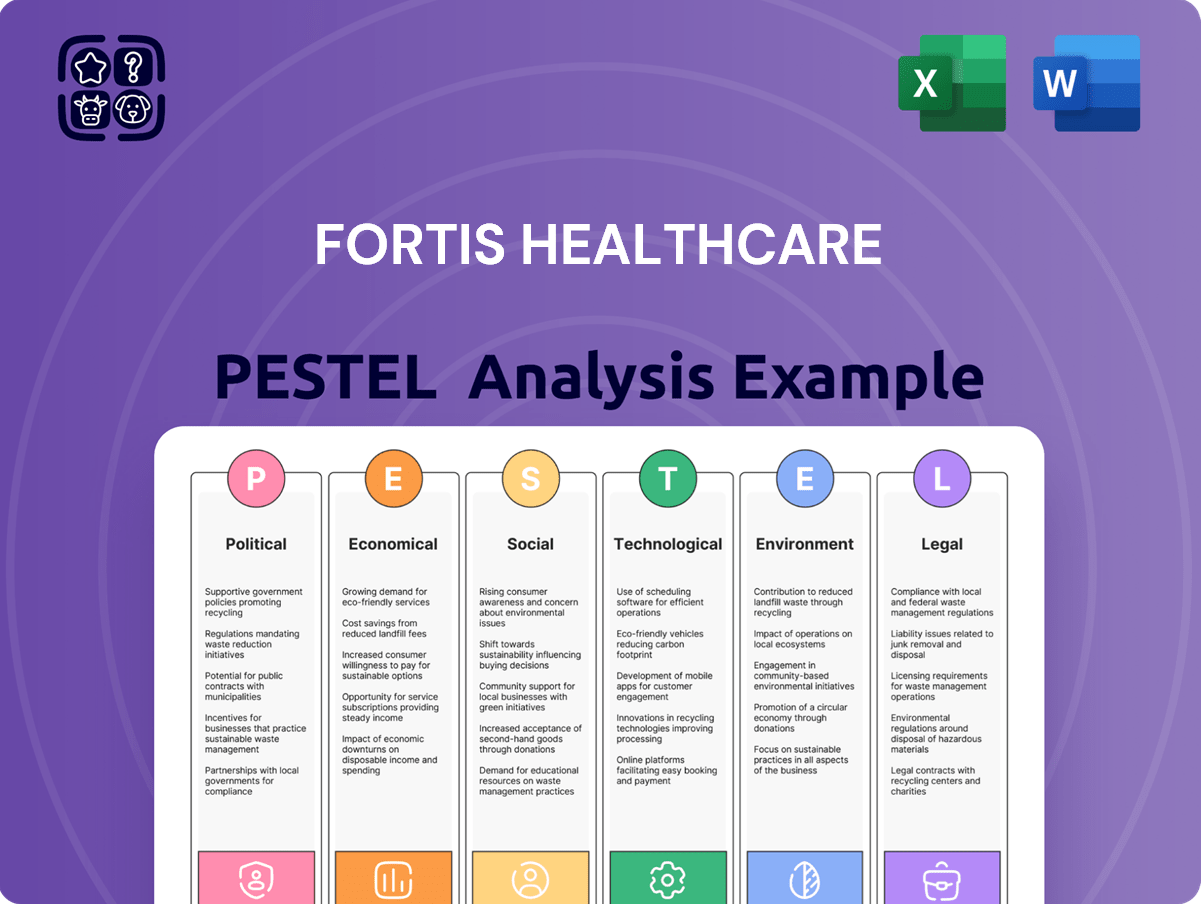
A concise Fortis Healthcare PESTLE snapshot that’s visually segmented for quick interpretation, easily dropped into presentations or shared across teams to support planning discussions on external risks, regulatory shifts, and market positioning.
Economic factors

Rising Disposable Income
Rising disposable income—India’s per capita income grew to about $2,562 in FY2024 and the middle class expanded to ~360 million—drives higher spending on premium and elective healthcare, boosting demand for Fortis’s services; as household wealth rises, patients increasingly prefer organized chains over smaller clinics, supporting Fortis’s ARPOB, which averaged around INR 96,000 in FY2024.
Inflationary Pressures on Operations
Persistent inflation in medical consumables (+9-11% YoY in India 2024), rising energy costs (industrial LPG, diesel up ~18% YoY) and specialist salaries (doctor/nurse pay up 7-10% in 2023-24) compress Fortis Healthcare’s operating margins, which were 8.2% in FY2024. The company must balance partial cost-pass-through with price-sensitive demand in private care. Enhanced supply-chain sourcing, bulk procurement and operational efficiencies (targeting 150-200 bps margin recovery) are critical to mitigate these macro headwinds.

Health Insurance Penetration
Rising private health insurance penetration—urban coverage rising to about 30–35% in 2024 from ~24% in 2019—lowers out-of-pocket spending and prompts earlier care seeking, boosting patient volumes for Fortis; higher insured mix improves receivables realization and cut bad-debt ratios (industry hospital NPAs fell toward 2–3% in 2023–24), supporting steadier cash flows under a third-party payer model.

Interest Rate Environment
The late-2025 RBI policy rate at 6.5% raises Fortis Healthcare’s weighted average cost of debt for brownfield and greenfield projects, likely curbing CAPEX and shifting emphasis to asset-light collaborations and leased facilities.
If rates stabilize near 6.0–6.5%, Fortis can resume aggressive scaling of Agilus Diagnostics; Agilus reported 18% YoY revenue growth through H1 2025, supporting expansion under lower funding costs.
- Higher rates (RBI policy ~6.5%) increase debt service, tightening CAPEX
- Asset-light models and partnerships reduce balance-sheet leverage
- Rate stabilization (~6.0–6.5%) enables faster Agilus Diagnostics rollout after 18% H1 2025 revenue growth
Urbanization and Infrastructure Growth
- Urban share ~40% (2024)
- Target cities: Gurugram, Pune, Jaipur
- Hub-and-spoke boosts catchment, occupancy
- Transport services growth 10–15% YoY
Rising incomes, insurance lift demand; inflation squeezes margins as rates climb
Higher disposable income (per capita ~$2,562 in FY2024) and ~360M middle class boost demand and ARPOB (~INR 96,000 FY2024); inflation in medical consumables (+9–11% 2024) and wages compress margins (8.2% FY2024); rising insurance penetration (30–35% 2024) improves collections; RBI rate ~6.5% late-2025 raises cost of debt, favoring asset-light expansion and Agilus growth (18% H1 2025).
| Metric | Value/Year |
|---|---|
| Per capita income | $2,562 FY2024 |
| Middle class | ~360M 2024 |
| ARPOB | INR 96,000 FY2024 |
| Hospital margin | 8.2% FY2024 |
| Medical inflation | +9–11% 2024 |
| Insurance penetration | 30–35% 2024 |
| RBI policy rate | ~6.5% late-2025 |
| Agilus growth | +18% H1 2025 |
Preview Before You Purchase
Fortis Healthcare PESTLE Analysis
The preview shown here is the exact Fortis Healthcare PESTLE document you’ll receive after purchase—fully formatted, professionally structured, and ready to use.

- Choosing a selection results in a full page refresh.