Currency
 AED
AED
 AFN
AFN
 ALL
ALL
 AMD
AMD
 ANG
ANG
 AUD
AUD
 AWG
AWG
 AZN
AZN
 BAM
BAM
 BBD
BBD
 BDT
BDT
 BIF
BIF
 BND
BND
 BOB
BOB
 BSD
BSD
 BWP
BWP
 BZD
BZD
 CAD
CAD
 CDF
CDF
 CHF
CHF
 CRC
CRC
 CVE
CVE
 CZK
CZK
 DJF
DJF
 DKK
DKK
 DOP
DOP
 DZD
DZD
 EGP
EGP
 ETB
ETB
 EUR
EUR
 FJD
FJD
 FKP
FKP
 GBP
GBP
 GMD
GMD
 GNF
GNF
 GTQ
GTQ
 GYD
GYD
 HNL
HNL
 HUF
HUF
 IDR
IDR
 ILS
ILS
 INR
INR
 ISK
ISK
 JMD
JMD
 JPY
JPY
 KES
KES
 KGS
KGS
 KHR
KHR
 KMF
KMF
 KRW
KRW
 KYD
KYD
 KZT
KZT
 LAK
LAK
 LBP
LBP
 LKR
LKR
 MAD
MAD
 MDL
MDL
 MKD
MKD
 MMK
MMK
 MNT
MNT
 MUR
MUR
 MVR
MVR
 MWK
MWK
 MYR
MYR
 NGN
NGN
 NIO
NIO
 NPR
NPR
 NZD
NZD
 PEN
PEN
 PGK
PGK
 PHP
PHP
 PKR
PKR
 PLN
PLN
 PYG
PYG
 QAR
QAR
 RON
RON
 RSD
RSD
 RWF
RWF
 SAR
SAR
 SBD
SBD
 SEK
SEK
 SGD
SGD
 SHP
SHP
 SLL
SLL
 STD
STD
 THB
THB
 TJS
TJS
 TOP
TOP
 TTD
TTD
 TZS
TZS
 UAH
UAH
 UGX
UGX
 USD
USD
 UYU
UYU
 UZS
UZS
 VND
VND
 VUV
VUV
 WST
WST
 XAF
XAF
 XCD
XOF
XPF
XCD
XOF
XPF
 YER
YER



Description
x
Your Shortcut to Market Insight Starts Here
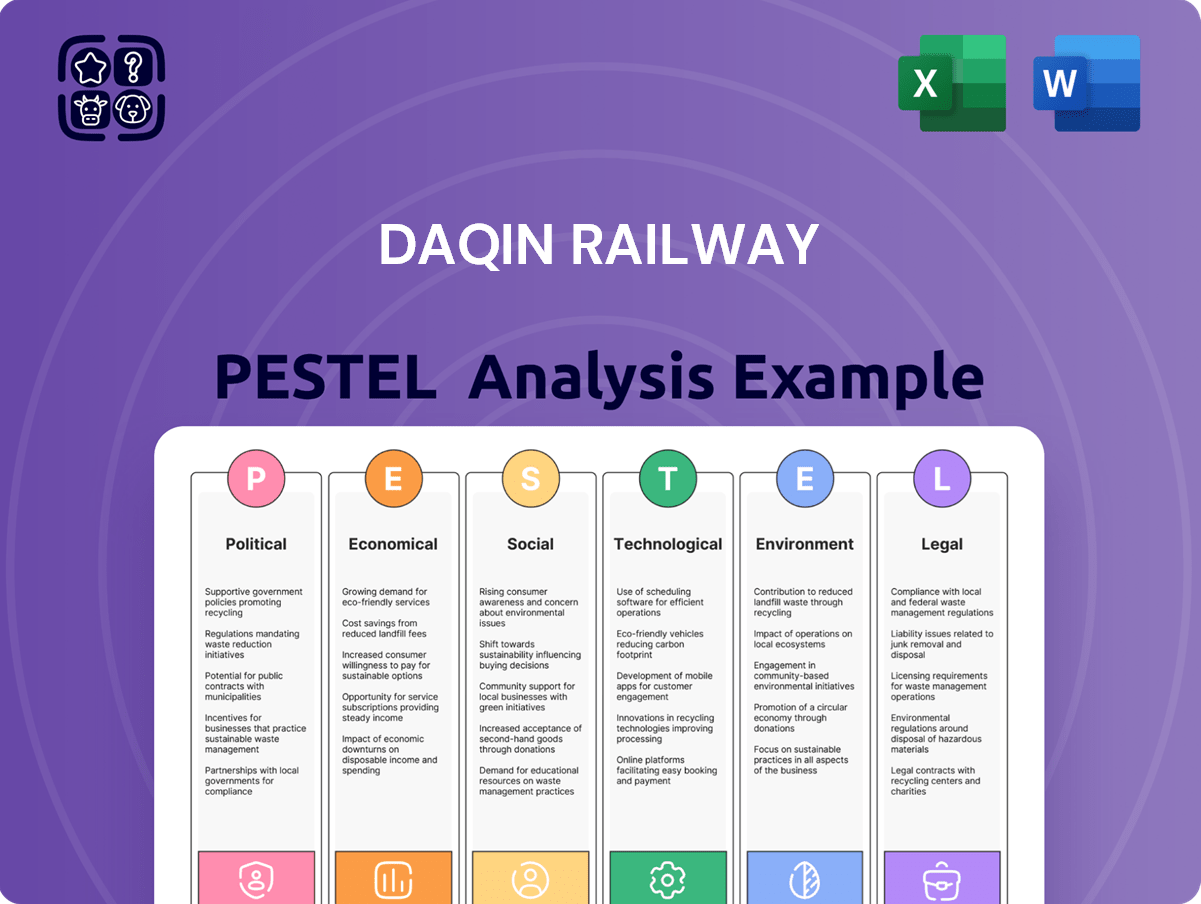
Discover how political shifts, rail policy, environmental constraints, and tech modernization are shaping Daqin Railway’s future—our concise PESTLE snapshot highlights the external forces that matter to investors and strategists. Purchase the full PESTLE analysis for a complete, actionable breakdown you can use in forecasts, due diligence, or competitive planning.
Political factors

National Energy Security Strategy
The Chinese government in 2025 reaffirmed coal as a core energy source, targeting coal-fired stability to secure the grid amid geopolitical risks; national plans aim to keep coal generation above ~55% of total power in winter peak months. Daqin Railway, transporting over 300 million tonnes annually from Shanxi to the eastern seaboard, is designated a strategic corridor. Policy directives late 2025 mandate prioritized freight slots and contingency reserves on the Daqin line to avert seasonal shortages.
State Ownership and Centralized Planning
As a subsidiary of China State Railway Group, Daqin Railway benefits from state backing that secured prioritized access to track capacity and capital—central government rail investment was RMB 1.2 trillion in 2024—shaping its network expansion and rolling stock upgrades. National planning directs corridor development, steering Daqin’s capex and route priorities and limiting private competitors while obliging alignment with China’s GDP growth and carbon-reduction targets.

Inter-Regional Cooperation Policies
Political initiatives to balance regional development have boosted transfers from western/central China to the east, with West-to-East coal transport policy increasing coal rail throughput by about 8.5% in 2024; Daqin Railway, carrying roughly 60% of coal traffic from Shanxi to Hebei/Beijing, is a primary beneficiary. Stronger interprovincial coordination among Shanxi, Hebei and Beijing cut administrative approval times for upgrades by an estimated 30%, accelerating maintenance and expansion projects.

Geopolitical Trade Dynamics
- 2024: domestic rail coal volumes +7% amid import reductions
- 2025: Daqin tonnage +4–6% YoY; handles ~60% northern coal logistics
- Potential import share variance ±10–15% from trade/sanction shifts
Railway Reform and Deregulation
Ongoing railway reform in China pushes market-oriented mechanisms while retaining state control; mixed-ownership pilots rose to 1,000+ enterprises by 2024, affecting asset allocation at Daqin Railway (SHA: 601006) whose 2024 freight revenue was RMB 36.8 billion, up 3.2% y/y.
Policies promoting improved corporate governance and transparency, including SOE supervision reforms from 2023–2025, increase institutional investor appeal and may lower Daqin's cost of capital through clearer disclosure and board diversification.
- Mixed-ownership expansion: 1,000+ pilots by 2024
- Daqin freight revenue 2024: RMB 36.8B (+3.2% y/y)
- SOE governance reforms 2023–2025 improve transparency
- Privatization unlikely; focus on efficiency and institutional access
Daqin: Strategic 300Mt Coal Corridor as 2025 Policy Boosts Rail Volumes & Investor Access
State energy policy in 2025 prioritizes coal (winter coal generation >55%), making Daqin a strategic corridor handling ~300Mt pa and +4–6% tonnage YoY; 2024 rail coal volumes rose 7% as imports fell. As an SOE subsidiary, Daqin (SHA:601006) got prioritized slots and capex; 2024 freight revenue RMB36.8B (+3.2%). Governance reforms (2023–25) and mixed-ownership pilots (1,000+ by 2024) improve investor access.
| Metric | 2024 | 2025 |
|---|---|---|
| Daqin tonnage | ~300Mt | +4–6% YoY |
| Rail coal volumes | +7% (imports down) | — |
| Freight revenue | RMB36.8B (+3.2%) | — |
| Mixed-ownership pilots | 1,000+ | — |
What is included in the product
 Detailed Word Document
Explores how Political, Economic, Social, Technological, Environmental and Legal forces uniquely affect Daqin Railway—grounded in regional energy demand, freight policy, infrastructure investment, decarbonization targets, digital logistics trends, and regulatory tariff frameworks—to help executives and investors identify risks, opportunities and actionable scenarios for strategic planning.

 Customizable Excel Spreadsheet
Concise PESTLE summary tailored for Daqin Railway, visually segmented by category to support quick stakeholder alignment and risk discussions during planning or investor meetings.
Economic factors

Industrial Demand in Eastern China
Industrial demand in Eastern China—notably the Yangtze River Delta (GDP ~US$2.3 trillion in 2024) and Pearl River Delta (GDP ~US$1.6 trillion)—drives coal volumes; manufacturing PMI for these regions averaged ~50.8 in 2024, supporting steady thermal coal shipments.
Coal Price Volatility
Fluctuations in coal prices directly affect mining margins and demand for Daqin Railway’s long-haul services; benchmark thermal coal fell ~18% in 2024 then recovered ~12% by mid-2025, contributing to a 5–8% swing in transported volume year-on-year. Daqin’s fixed-rate contracts limit short-term revenue flexibility, but prolonged price drops cut production and volumes, while price spikes have led regulators in 2024–25 to consider tariff caps, making coal-sector stability a key driver of Daqin’s 2025 financials.

Infrastructure Investment and Capital Costs
Maintaining and upgrading Daqin Railway’s heavy-haul infrastructure requires large CAPEX—China’s railway fixed-asset investment was 1.57 trillion CNY in 2024—making costs sensitive to prevailing interest rates and credit availability.
China’s average corporate bond yield fell to about 3.8% in 2024, directly affecting project debt costs for advanced signaling and track reinforcement programs.
Efficient capital management is essential to preserve Daqin’s dividend payout—the company paid a 2024 dividend yield near 3.2%—so financing decisions balance infrastructure needs against investor cash returns.

Competition from Alternative Transport Modes
Competition from coastal shipping and new pipelines pressures Daqin Railway's economics; in 2024 coastal bulk freight rates fell about 8% year-on-year, and Bohai and northern ports increased coal throughput by 6% to ~880 million tonnes, risking modal shift.
Rail still leads inland bulk cost-efficiency, but Daqin must hold unit rail tariffs and lift efficiency (2024 average train turnaround ~18 hours) to retain clients against lower maritime/pipeline unit costs.
- 2024 coastal freight rates down ~8%
- Northern port coal throughput +6% (~880 Mt)
- Avg train turnaround ~18 hrs (2024)
- Need competitive unit tariffs and high efficiency
Inflation and Operational Expenses
Rising costs for electricity, labor, and steel — electricity up ~12% YoY in China 2024, average industrial wages up ~5% and steel prices +8% — pressure Daqin Railway margins given high energy use for electric locomotives and heavy track maintenance.
Management must pursue efficiency gains, renegotiated power contracts, predictive maintenance and rolling-stock energy optimization to offset inflation in a mature freight market where 2024 coal-transport volumes remained near prior-year levels.
- Electricity +12% (2024 China industrial index)
- Wages +5% YoY (2024 national average)
- Steel +8% (2024 domestic rebar/rail prices)
- Actions: power contracts, predictive maintenance, energy-efficient rolling stock
Delta industrial demand cushions coal volumes amid volatile prices and rising input costs
Industrial demand in Yangtze (GDP ~US$2.3T 2024) and Pearl River (~US$1.6T 2024) deltas sustains coal volumes; regional PMI ~50.8 (2024). Coal price volatility (−18% 2024, +12% recovery by mid‑2025) drove 5–8% volume swings; regulators eyed tariff caps. CAPEX needs (rail FAI 1.57T CNY 2024) and lower corporate yields (3.8% 2024) shape financing; input cost inflation (electricity +12%, wages +5%, steel +8% 2024) compresses margins.
| Metric | 2024/2025 |
|---|---|
| Yangtze GDP | ~US$2.3T (2024) |
| Pearl GDP | ~US$1.6T (2024) |
| Coal price change | −18% (2024), +12% to mid‑2025 |
| Rail FAI | 1.57T CNY (2024) |
| Corp bond yield | ~3.8% (2024) |
| Electricity / Wages / Steel | +12% / +5% / +8% (2024) |
What You See Is What You Get
Daqin Railway PESTLE Analysis
The preview shown here is the exact Daqin Railway PESTLE Analysis you’ll receive after purchase—fully formatted, professionally structured, and ready to use for strategic decision-making and valuation work.

- Choosing a selection results in a full page refresh.