Currency
 AED
AED
 AFN
AFN
 ALL
ALL
 AMD
AMD
 ANG
ANG
 AUD
AUD
 AWG
AWG
 AZN
AZN
 BAM
BAM
 BBD
BBD
 BDT
BDT
 BIF
BIF
 BND
BND
 BOB
BOB
 BSD
BSD
 BWP
BWP
 BZD
BZD
 CAD
CAD
 CDF
CDF
 CHF
CHF
 CRC
CRC
 CVE
CVE
 CZK
CZK
 DJF
DJF
 DKK
DKK
 DOP
DOP
 DZD
DZD
 EGP
EGP
 ETB
ETB
 EUR
EUR
 FJD
FJD
 FKP
FKP
 GBP
GBP
 GMD
GMD
 GNF
GNF
 GTQ
GTQ
 GYD
GYD
 HNL
HNL
 HUF
HUF
 IDR
IDR
 ILS
ILS
 INR
INR
 ISK
ISK
 JMD
JMD
 JPY
JPY
 KES
KES
 KGS
KGS
 KHR
KHR
 KMF
KMF
 KRW
KRW
 KYD
KYD
 KZT
KZT
 LAK
LAK
 LBP
LBP
 LKR
LKR
 MAD
MAD
 MDL
MDL
 MKD
MKD
 MMK
MMK
 MNT
MNT
 MUR
MUR
 MVR
MVR
 MWK
MWK
 MYR
MYR
 NGN
NGN
 NIO
NIO
 NPR
NPR
 NZD
NZD
 PEN
PEN
 PGK
PGK
 PHP
PHP
 PKR
PKR
 PLN
PLN
 PYG
PYG
 QAR
QAR
 RON
RON
 RSD
RSD
 RWF
RWF
 SAR
SAR
 SBD
SBD
 SEK
SEK
 SGD
SGD
 SHP
SHP
 SLL
SLL
 STD
STD
 THB
THB
 TJS
TJS
 TOP
TOP
 TTD
TTD
 TZS
TZS
 UAH
UAH
 UGX
UGX
 USD
USD
 UYU
UYU
 UZS
UZS
 VND
VND
 VUV
VUV
 WST
WST
 XAF
XAF
 XCD
XOF
XPF
XCD
XOF
XPF
 YER
YER



Description
x
Make Insightful Decisions Backed by Expert Research
Baoshan Iron & Steel’s SWOT highlights robust production scale and integrated supply chains that underpin resilience, but also exposure to cyclical steel demand and environmental compliance costs; strategic pivots in higher-margin downstream products and green steel could reshape its outlook. Discover the full SWOT analysis for research-backed insights, editable Word/Excel deliverables, and clear action steps to inform investment or strategic decisions.
Strengths

Dominant Market Position in High-End Steel
Baoshan Iron & Steel (Baosteel) is the premier supplier to China’s auto and home-appliance sectors, holding about 28% share in high-value steel by 2025 and pricing premiums 12–18% above commodity grades.
By end-2025 Baosteel led production of ultra-high-strength steel (UHS) at ~4.6 Mt and non-oriented silicon steel for EV motors at ~1.1 Mt, securing higher margins and long-term OEM contracts.
This specialization yields gross margins ~8–10 percentage points above commodity producers, creating a strong moat versus smaller domestic rivals and supporting EBITDA resilience.
Advanced R and D and Technological Innovation
Baoshan Iron & Steel (Baosteel) reinvests ~3.8% of annual revenue into R&D (2024–2025), keeping it at metallurgical frontiers; by Q4 2025 it commercialized three low-carbon steel processes that cut CO2 intensity by ~18% per tonne and launched five high-performance alloys achieving tensile gains of 12–28%. These products meet aerospace and high-end manufacturing specs, securing market access and long-term relevance in complex global supply chains.

Integration within China Baowu Group
As the core subsidiary of China Baowu Steel Group, the world’s largest steelmaker, Baoshan gains massive economies of scale—China Baowu produced ~119 million tonnes of crude steel in 2024—enabling lower unit costs and centralized procurement power.
Preferential access to iron ore and coking coal imports, plus a group logistics network covering 200+ terminals, trims supply-chain costs and inventory days; Baowu’s strategic capital support lifted Baoshan’s 2024 net debt/EBITDA to a sustainable level.
The parent’s policy influence helps shape domestic industry standards and secures market access, making this integration a central pillar of Baoshan’s operational resilience and competitive positioning.

State-of-the-Art Smart Manufacturing Facilities
Baosteel has rolled out Industry 4.0 across Shanghai and Zhanjiang; by end-2025 AI and digital-twin systems raised hot-rolling yield by ~2.8 percentage points and cut energy use per ton by ~6.5%, trimming variable costs.
Real-time monitoring lets plants shift schedules within hours to match spot demand, reducing inventory days and protecting margins in a ~3–5% steel-net-margin environment.
- AI + digital twin live since 2023–25
- Yield +2.8 pp by 2025
- Energy −6.5% per ton by 2025
- Schedule changes within hours
- Supports 3–5% net margins
Robust Financial Profile and Credit Rating
Baoshan Iron & Steel (Baosteel) shows a healthy balance sheet: net debt/EBITDA ~0.6x in 2024 and free cash flow of RMB 18.4bn, letting it self-fund capex and keep dividends through cycles.
Market sees Baosteel as low-risk; A-/A3 ratings and below-market borrowing costs enabled RMB bond issuances in 2024, supporting steady expansion and targeted acquisitions.
- Net debt/EBITDA ~0.6x (2024)
- Free cash flow RMB 18.4bn (2024)
- Investment-grade ratings: A-/A3 (2024)
- Self-funded capex and sustained dividends
Baosteel: High-value leader—28% share, premium pricing, strong margins & FCF
Baosteel dominates high-value auto/appliance steel (~28% share, 2025), commands 12–18% price premium, and led UHS (~4.6 Mt) and EV motor silicon steel (~1.1 Mt) by end-2025; gross margins ~8–10 pp above commodity peers. Net debt/EBITDA ~0.6x (2024), FCF RMB18.4bn; R&D ~3.8% revenue; AI yield +2.8 pp, energy −6.5% (2025).
| Metric | Value |
|---|---|
| High-value share (2025) | 28% |
| UHS prod (2025) | 4.6 Mt |
| Silicon steel (2025) | 1.1 Mt |
| Net debt/EBITDA (2024) | 0.6x |
| FCF (2024) | RMB18.4bn |
What is included in the product
 Detailed Word Document
Provides a clear SWOT framework for analyzing Baoshan Iron & Steel’s business strategy, highlighting its operational strengths, structural weaknesses, strategic opportunities, and external threats shaping future performance.

 Customizable Excel Spreadsheet
Provides a concise SWOT snapshot of Baoshan Iron & Steel for rapid strategic alignment and investor briefings.
Weaknesses

Heavy Reliance on Imported Raw Materials
High Environmental Compliance Costs
Transitioning to green steel forces Baoshan Iron & Steel to invest heavily in carbon capture and hydrogen smelting—CAPEX needs estimated at $6–10 billion industry-wide by 2030, and Baosteel’s pro rata share could be hundreds of millions through 2025–27.
China tightened emissions rules through 2025, and Baosteel faces fast cutbacks in CO2 intensity; mandatory upgrades raise annual compliance costs and can hit short-term liquidity.
These required expenditures divert funds from M&A and capacity expansion, squeezing free cash flow—Baowu reported RMB 25–40 billion capex cycles recently, so reallocations matter.
Maintaining price competitiveness while funding decarbonization remains a core internal trade-off that could compress margins if costs can’t be passed to customers.

Exposure to Domestic Real Estate Volatility

Operational Rigidity of State-Owned Enterprises
As a major state-owned enterprise, Baoshan Iron & Steel (Baosteel) balances profitability with national goals and social duties, which slowed major capex approvals—group capex was ¥23.6 billion in 2024, reflecting cautious allocation.
Obligations to keep employment and back government projects can conflict with optimal capital allocation, reducing ROE upside; 2024 ROE was ~4.8%.
This governance setup makes decision cycles longer than private peers, limiting agility when steel spot prices fell 12% in H2 2024.
- 2024 capex ¥23.6B
- 2024 ROE ~4.8%
- H2 2024 spot price drop ~12%
Product Concentration in Mature Segments
Despite Baoshan Iron & Steel’s high-tech push, about 45% of 2024 steel shipments still served mature segments—auto ICE components and consumer appliances—where global demand growth slowed to ~1.5% in 2024–25.
If Baosteel does not shift faster into niche materials (e.g., advanced automotive AHSS, electrical steel for EVs), excess capacity could drive margin erosion; FY2024 gross margin fell to 13.8% vs 16.2% in 2021.
Portfolio rebalance needs frequent capex and R&D spend—Baoshan reported R&D at 1.6% of revenue in 2024—raising restructuring and idle-asset costs while fighting commoditization.
- 45% output in mature segments (2024)
- Mature segment demand growth ~1.5% (2024–25)
- FY2024 gross margin 13.8% (down from 16.2% in 2021)
- R&D spend 1.6% of revenue (2024)
Ore price swings, China demand risk squeeze margins—ROE 4.8%, capex rises
High commodity exposure (70% ore from Australia/Brazil) and 2023–24 spot ore +35% swings squeeze EBITDA; 2024 ROE ~4.8% and gross margin 13.8% (2021:16.2%). Heavy China demand risk—utilization 78% (2024 vs 85% 2021). Decarbonization needs raise capex (pro rata hundreds of millions) and capex was ¥23.6B (2024); R&D 1.6% revenue (2024).
| Metric | 2024 |
|---|---|
| Ore import share | 70% |
| ROE | 4.8% |
| Gross margin | 13.8% |
| Utilization | 78% |
| Capex | ¥23.6B |
| R&D | 1.6% rev |
Full Version Awaits
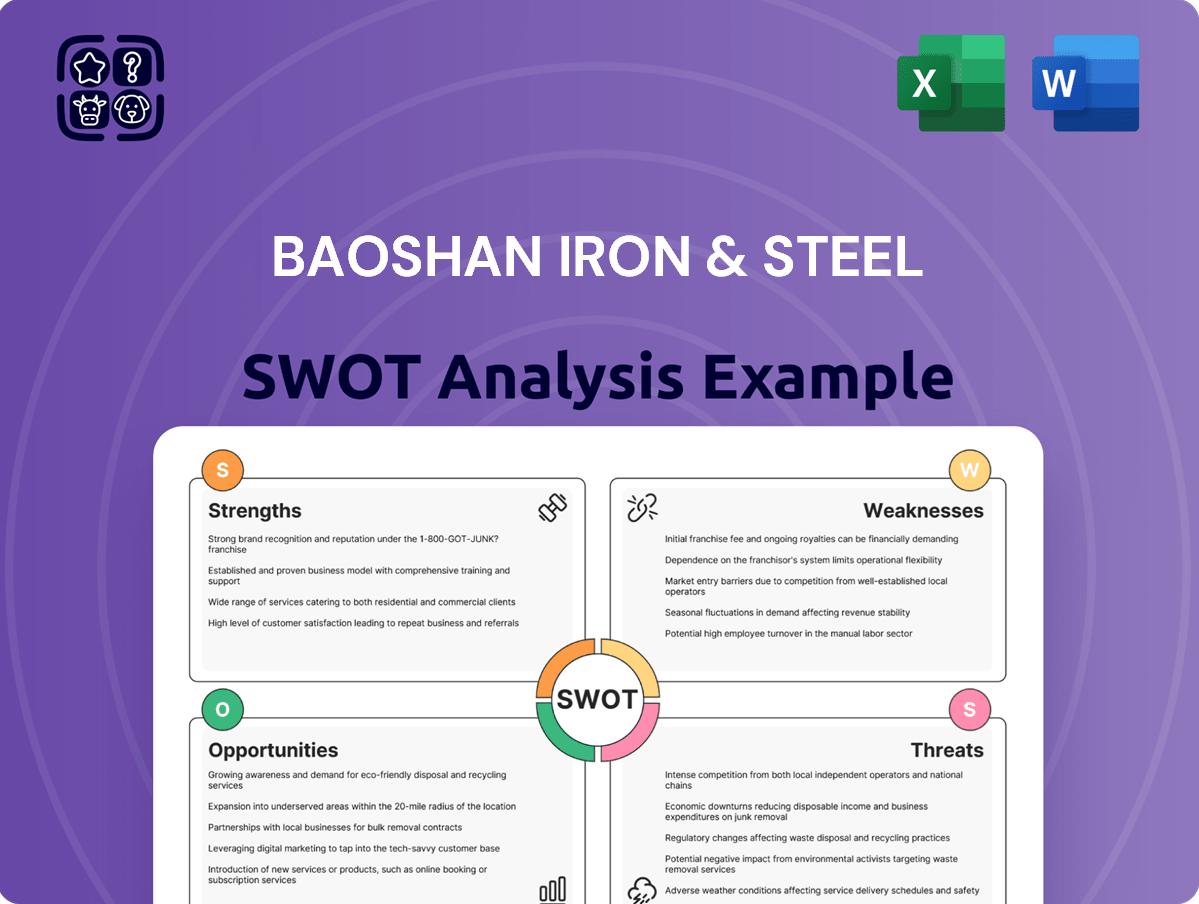
Baoshan Iron & Steel SWOT Analysis
This is the actual SWOT analysis document you’ll receive upon purchase—no surprises, just professional quality.
The preview below is taken directly from the full SWOT report you'll get. Purchase unlocks the entire in-depth version.
This is a real excerpt from the complete document. Once purchased, you’ll receive the full, editable version.

- Choosing a selection results in a full page refresh.